2026 International Conference of New Praxis and Taiwan-Japan Alliance of Regional Revitalization and Social Practice
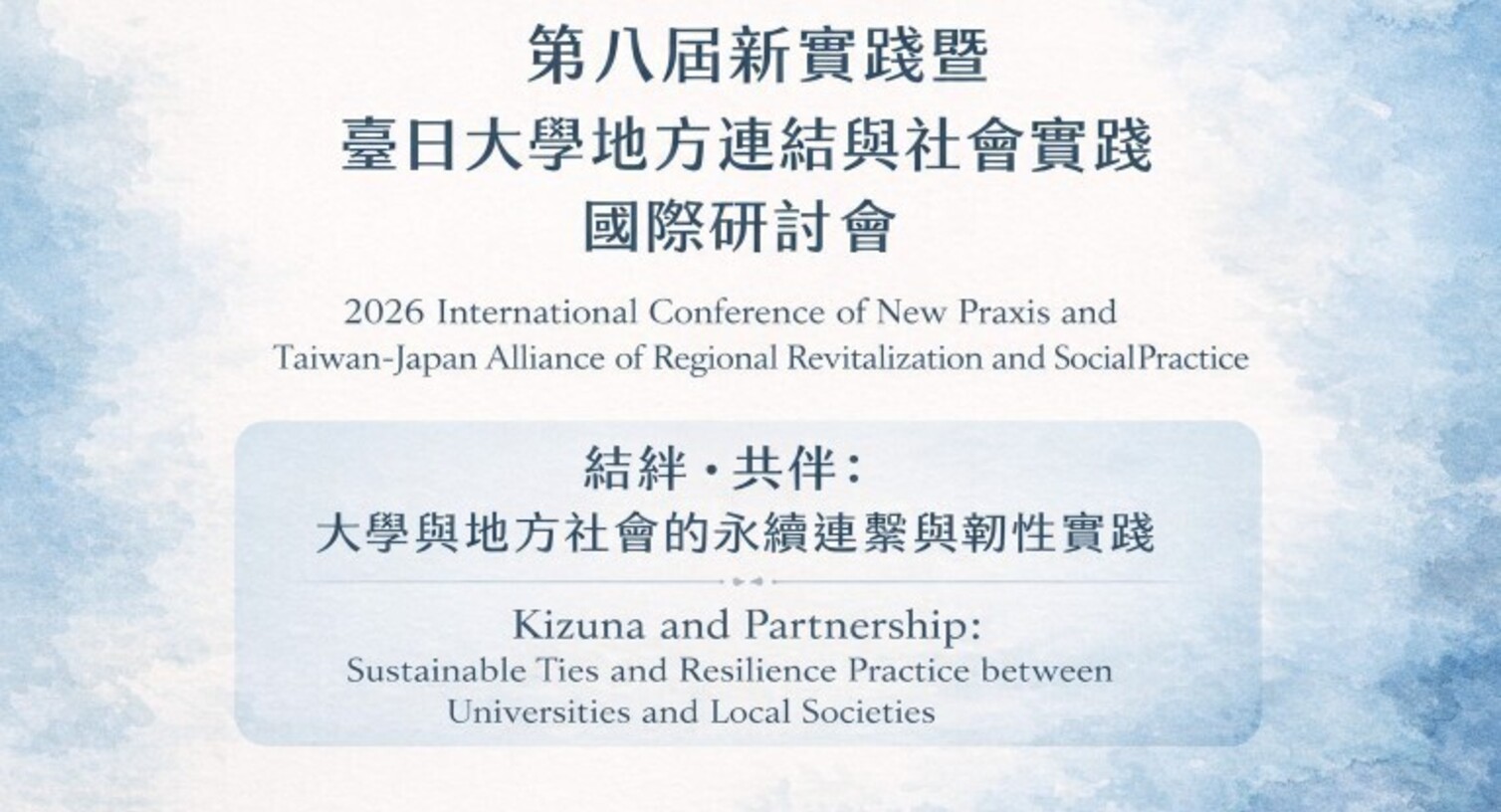
 【Theme】Kizuna and Partnership: Sustainable Ties and Resilience Practice between Universities and Local Societies
1.Introduction
The 8th International Conference on New Praxis and the Taiwan-Japan University Alliance for Local Connection and Social Practice will be held at National Taiwan Ocean University, a venue uniquely situated at the confluence of mountains and sea. From the perspective of maritime history, the ocean has never been a barrier that separates different regions and cultures. Rather, it serves as an interface that facilitates cross-border flow and connectivity. This "flow" symbolizes the exchange of culture and the tides of emotion that ebb and flow across boundaries. Beneath these waves lies the "Kizuna" (絆), a bond as stable and profound as deep ocean currents.
In recent years, amid the waves of global demographic change and social transformation, the issues faced by local societies in Taiwan and Japan are no longer isolated or independent problems. Instead, they have increasingly become intertwined, forming long-term and structural challenges concerning the very survival of local communities. In this context, the role of universities entering local communities has moved beyond temporary external intervention and transformed into a form of “ongoing companionship.”
Like the tides of the ocean, such companionship represents a constant yet rhythmic presence. It is manifested not only through long-term on-site engagement in local communities but also in how universities utilize technological media to weave new forms of connectivity within spaces where the digital and physical intersect. Furthermore, through the promotion of international recurrent education for adults, learners across borders and generations can collectively become a new driving force that bolsters local resilience.
The Japanese term "Kizuna" depicts a resilient bond between people, while the Chinese terms "Peipan" (Companionship) and "Huopan" (Partnership) emphasize how universities establish a sustainable tie with local communities in an ever-shifting contemporary society. This tie represents a cross-generational, cross-organizational, and cross-cultural connection, allowing the innovative vitality of university knowledge to surge into local areas like waves, while the local knowledge accumulated by elders through their life experiences settles as a foundational bedrock.
This conference cordially invites scholars and practitioners from Taiwan and Japan engaged in social practice to jointly explore the following: How can universities, through fluid strategies of local engagement, transcend organizational silos to build platforms of trust via mutual listening and dialogue? Furthermore, how can the deep emotional resonance emerging across disciplines, organizations, and nations be transformed into a cornerstone of local resilience? We look forward to university partners and community practitioners from diverse local societies as they distill their practical experiences into knowledge through sharing and exchange, thereby collectively composing a new chapter of co-existence and companionship between universities and local communities.
2.Topics of Interest
(1)Cross-Regional Social Practice from a Maritime Perspective
Theoretical discourses on the ocean as a connective interface; construction of cross-island and international social practice networks; cultural flow and geopolitical practice under the framework of mountain-sea symbiosis.
(2)The Daily Life Practice and Institutionalization of Universities in Local Societies
Methodologies of "daily life companionship" in long-term community engagement; mechanisms for transforming companionship into institutional support; trust-building and partnership under asymmetrical power dynamics.
(3)Intergenerational Collaboration and Translation of Local Knowledge
Modern translation and digital revitalization of local knowledge; dialogue and co-creation between youth creativity and local craftsmanship; construction of a "sustainable tie" through intergenerational co-learning; the role and practice of universities as platforms for international recurrent education; preservation of cultural memory and value recognition in social practice.
(4)Relationship Population Dynamics and Sustainable Pathways for Local Revitalization
The emotional bonds and local identification of “relationship populations” (including university social practice teams); the strategies for transforming relationship populations into permanent settlers; the value of fluid resources for the socio-economic resilience of local communities; the dynamic relationships among migration, return migration, and local revitalization; strategies for strengthening local connectivity via AI or digital media.
(5)Environmental Sustainability and Local Circular Economy Practices
Local implementation of Sustainable Development Goals (SDGs); green transformation and sustainable management of primary industries (agriculture, forestry, fisheries, and livestock); dynamic governance of energy reduction and environmental resources at the community scale; social solidarity and economic resilience in circular economy models.
(6)Aging in Place, Community Health, and All-Age Friendly Support Systems
"Companionship-based" elderly care networks and community support systems; intergenerational co-living and mutual aid models; social application of smart technology and telemedicine in rural areas; design and practice of all-age friendly environments for aging in place.
(7)Local Disaster Resilience and Risk Governance Practice
Community resilience building under conditions of extreme environmental change; the systematic integration of local knowledge with contemporary disaster prevention technologies; grassroots mutual-aid networks and response mechanisms; practical experiences of universities assisting local communities in developing risk governance.
(8)Pedagogical Innovation and Talent Cultivation in Social Practice
Innovation in field-based teaching methodologies and assessment; university curricula as community participation mechanisms (Campus as a Lab); cultivation of cross-disciplinary mobility and social responsibility; lineage development and long-term tracking of social practice talent.
(9)Methods and Methodology of University Social Practice
Localization of Action Research in cross-cultural contexts; knowledge production models that transcend organizational silos; ethical reflections and role conflicts in university-local partnerships; distillation of practical experience into theoretical knowledge and narrative strategies.
(10)Other Issues Related to Social Practice, Community Building, and Local Connectivity
3.Conference Information
(1)Conference Date: September 1, 2026 (Tue.)
(2)Conference Venue: College of Humanities and Social Sciences , National Taiwan Ocean University(No.2, Beining Rd., Zhongzheng Dist., Keelung City 202301, Taiwan)
Advisor|Department of Humanities and Social Sciences, National Science and Technology Council
Host|Office of Humanity Innovation and Social Practice Project, National Science and Technology Council; Taiwan-Japan Alliance of Local Revitalization and Social Practice
4.Submission Guidelines
✒️Types of Submissions: Abstract for Full paper, Poster, and Self-Organized Panel
✒️Review Method: Peer review among session presenters (The organizers will provide the email addresses of the presenters for sending the full text).
✒️Deadline for Abstract Submission: May 31, 2026 (Sun.)
✒️Notification of Acceptance: June 5, 2026 (Fri.)
✒️Poster Submission Deadline: July 31, 2026 (Fri.); Please send the file to hisp.newpraxis@gmail.com
✒️Deadline for Full Paper Submission: August 10, 2026 (Mon.)
(1)Regardless of the submission category, both an abstract in the author's primary language—either Chinese or Japanese—and an English translation are required. The abstract should be approximately 400–500 words in length and must clearly present the research phenomenon, methodology, and findings.
Please download the appropriate registration form according to the submission type (Paper Abstract Submission Form https://reurl.cc/bdYLmM , Poster Abstract Submission Form https://reurl.cc/9W3NG8 , or Self-Organized Forum Submission Form https://reurl.cc/mpy53G ). Completed forms should be sent to: hisp.newpraxis@gmail.com
(2)For this submission, research papers are not required to be submitted to the organizers. Instead, presenters must email a PDF copy of their full paper directly to the discussants of their respective sessions by the deadline. The full text should be between 6,000 and 15,000 words (excluding references and appendices). In addition to the main body of the paper, the content must include: a title, abstract, three keywords, full names of authors, affiliations, email addresses, and positions.
(3)For poster submissions, a file that meets the poster presentation specifications must be submitted. The text on the poster must be in English, and the content should include: the title, abstract, full names of authors, affiliations, email addresses, and positions. No full text of the article is required for poster submissions.
[Poster Size and File Specifications]
🔖Vertical A0 size [Width: 841 mm x Height: 1,189 mm]
🔖File format: PDF, size not exceeding 15MB, resolution above 300dpi.
We sincerely invite scholars, practitioners, and social innovation advocates to submit their work and collaboratively explore how partnerships between universities and local communities can transcend multiple boundaries to foster sustainable and resilient social practices.
NOTES
1. All submissions must be made online. Please download and complete the appropriate registration form according to your submission type. Once completed, the form should be sent to the designated email address: hisp.newpraxis@gmail.com
2.The abstract submitted for this conference will be used for the printing of the program booklet and will not be subject to revision after submission. Please take note.
3.This conference does not require submission of full papers to the organizers. Presenters are asked to submit their PDF files to session reviewers for feedback before the submission deadline.
4.The conference handbook will primarily be available in digital format, with a limited number of printed copies. It will include the abstracts of the presenters' papers. By submitting your abstract, you consent to its electronic and/or print publication.
5.The organizers reserve the right to make final modifications, changes, and explanations of the event, or to cancel the event. Any relevant changes will be announced on the website, and no further notifications will be issued.