 National Kaohsiung University of Science and Technology
Taiwan Member Universities
 National Taiwan Ocean University
 National Chi Nan University
 National Cheng Kung University
- National Kaohsiung University of Science and Technology
 National Sun Yat-sen University
 Tunghai University
 National Pingtung University
 National Chengchi University
Japanese Member Universities


National Kaohsiung University of Science and Technology
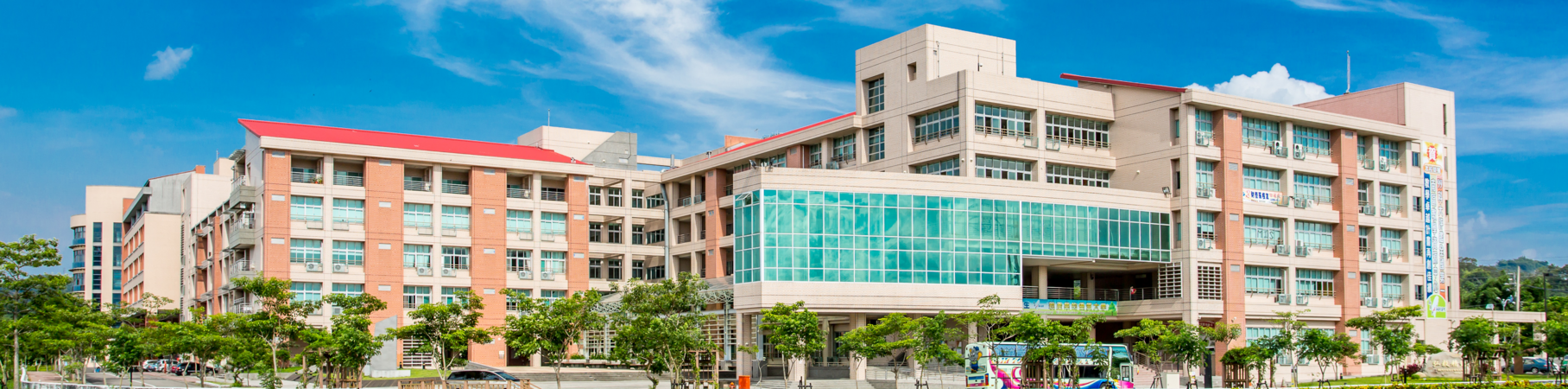
National Kaohsiung University of Science and Technology (NKUST) was established in 2018 through the merger of three national universities of science and technology, and is currently the largest university of science and technology in Taiwan. The university operates across 5 campuses, featuring 10 academic colleges, 50 departments, 56 master's programs, and 17 doctoral programs, covering diverse fields such as engineering, electrical engineering and computer science, management, marine science and technology, and humanities and social sciences. With over 860 professors and 26,000 students, NKUST possesses abundant teaching and research resources. In terms of international exchange, NKUST has established sister school partnerships with 504 universities worldwide and offers 13 dual-degree programs. Integrating its three major development characteristics—"strong industry-academia links," "innovation and entrepreneurship," and "marine science and technology"—and strategically located at the geographical core of the Southern Semiconductor S-Corridor, NKUST continues to maximize the synergistic effects of the merger while further deepening its international cooperation and exchanges.
National Kaohsiung University of Science and Technology (NKUST) upholds the core philosophy of "a human-centric approach " and an operational model of "Value Co-creation" to fulfill its mission in talent cultivation, industry-academic R&D, and international networking. The university has integrated the practice of Social Responsibility into its Mid-to-Long-Term Institutional Development Plan, aiming for the vision of contributing to balanced urban-rural development.
Regarding the Ministry of Education's University Social Responsibility (USR) Project, NKUST's achievements are as follows:
- Phase I (2018–2019): 8 projects approved; total funding reached NT$77.78 million.
- Phase II (2020–2022): 5 projects approved; total funding reached NT$99.6 million.
- Phase III (2023–2024): 5 projects approved; total funding reached NT$65.6 million.
- Phase IV (2025–2027): 1 project approved; total funding reached NT$11.5 million.
With the highest total number of approved projects and total subsidies among all public and private universities in Taiwan, NKUST demonstrates its leading capacity and ambition in advancing social responsibility. To effectively align with Kaohsiung's industrial characteristics and urban-rural planning, the university focuses on five key dimensions: International Development, Maritime Development, Agricultural Development, Environmental Development, and Urban-Rural Development. Beyond fulfilling planned project tasks and indicators, NKUST will continue to identify regional issues, strengthen sustainable field management through external resource integration, and align with the Global Sustainable Development Goals (SDGs).
NKUST adopts a human-centered approach and a value co-creation model to fulfill its missions in talent development, industry–academia collaboration, R&D, and international engagement. By integrating University Social Responsibility (USR) into its mid- to long-term institutional development plan, the university aims to promote balanced urban–rural development. NKUST has consistently led Taiwan’s public and private universities in both total project count and total subsidies across four phases of the Ministry of Education’s USR projects: securing 8 projects (NT$77.78 million) in Phase I, 5 projects (NT$99.6 million) in Phase II, 5 projects (NT$65.6 million) in Phase III, and 1 project (NT$11.5 million) in Phase IV. To effectively align with Kaohsiung’s industrial characteristics and regional planning, the university focuses on five dimensions—international, maritime, agricultural, environmental, and urban-rural development—to strengthen sustainable field management and connect with Global Sustainable Development Goals (SDGs).
Currently, NKUST is actively implementing five core USR projects to transform academic capabilities into practical action. These include the "Sustainable Coastal Revitalization—Highway 17 Fishing Village Practice Project" in Yongan, Kaohsiung; the "Good Neighbors, Good Fish" international local revitalization initiative across fishing communities and elementary schools in Linbian, Jiadong, and Donggang; and the "Trendy Xinyuan" project focused on ornamental aquarium talent cultivation in Pingtung and Kaohsiung. Additionally, the university promotes the "Nanxi Revitalization" project in Tainan, using music to safeguard cultural memory alongside disaster prevention, and executes a public service-oriented vehicle modification project centered on disaster relief and long-term care needs across Southern Taiwan. Through these efforts, NKUST continues to drive co-prosperity between urban and rural areas.
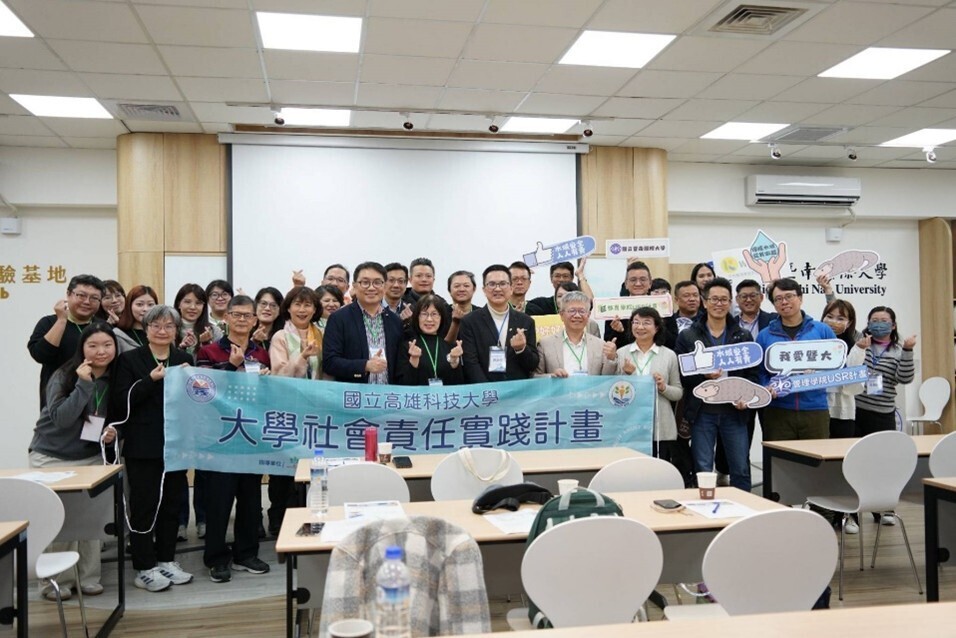
【USR “Good Neighbor Fisheries” Development Project】
Linbian Fishing Village, Pingtung
The Linbian, Jiadong, and Donggang areas in Pingtung are key aquaculture hubs in Taiwan. This project focuses on issues such as population aging in fishing communities, youth outmigration, industrial transformation, cultural heritage, and aquatic food education. By highlighting and strengthening the distinctive characteristics of these fishing communities, the project seeks to co-create pathways toward sustainable development.
Yongan Fishing Village, Kaohsiung
Yongan District is widely recognized as a major hub for grouper aquaculture. The NKUST team promotes economic development in fishing communities through the systematic mapping of local resources and the effective utilization of fishery assets. By integrating local aquatic products with the needs of the aging population, the team develops innovative products and establishes a localized economic cycle.
Xinyuan, Pingtung
Xinyuan Township in Pingtung is a key hub of Taiwan’s ornamental fish industry, with a strong foundation in aquaculture. However, it faces challenges such as declining youth participation in the industry and insufficient marketing capacity. Through cross-university collaboration and partnerships with local associations, this project promotes aquatic food education and the adoption of AI-driven smart technologies. These efforts aim to transform traditional aquaculture practices and advance the sustainable development of fishing communities.
Nanxi, Tainan
Nanxi District is endowed with rich agricultural products and cultural resources, including the Jiang Family Ancestral House. However, it faces challenges such as insufficient industrial integration, youth outmigration, and an aging population. In response to issues including post-disaster reconstruction, demographic aging, and the fragmentation of cultural memory, this project is structured around the core pillars of culture, disaster preparedness, and local revitalization. By embedding university faculty and students within the community, the project fosters a collaborative model of co-working and co-learning with local residents. Through this process, cultural resources and disaster awareness are translated into locally rooted assets, strengthening community resilience and promoting sustainable development. Using music and the arts as a bridge, the project seeks to re-engage community cohesion and preserve local cultural memory.
Kaohsiung–Pingtung Regional Vehicle Repair and Modification Workshop
This project focuses on the sustained development of the vehicle modification industry in the Kaohsiung–Pingtung region. It invests in upgrading the maintenance and modification sector for public-purpose vehicles, such as disaster relief and long-term care vehicles, while promoting road safety awareness and advocating for regulatory frameworks as well as the social and cultural value of public-purpose vehicle modifications. By redirecting technical assistance toward social practice, the project leverages university-based engineering expertise to respond to local needs and introduce public-oriented application scenarios. Through these efforts, it aims to transform industry culture, strengthen social trust, and enhance the sustainable development of the industry.
Kuang-Chung Tsai (Operations Committee Member)
President, Tungfang Design University Dean of Student Affairs, National Kaohsiung University of Science and Technology Dean of Office of Industry-Academia Collaboration, National Kaohsiung University of Science and Technology Dean of Office of Research and Development, National Kaohsiung University of Science and Technology Dean of Office of Research and Development, National Kaohsiung First University of Science and Technology Dean of Office of General Affairs, National Kaohsiung First University of Science and Technology Director, Center for Teaching and Research, Office of Academic Affairs, National Kaohsiung First University of Science and Technology Review Committee Member, Fire Protection Technology Review Committee, National Fire Agency, Ministry of the Interior Review Committee Member, Building Technology Review Committee, Construction and Planning Agency, Ministry of the Interior Review Committee Member, Civil and Architectural Engineering Technology Committee for National Standards, Bureau of Standards, Metrology and Inspection, Ministry of Economic Affairs Chairman, Taiwan Fireproof Materials Association Chairman, Taiwan Chapter, Society of Fire
Hang Lee (Nancy)(Newsletter Editorial Committee Member)
Division Chief of International Relations Division, Office of International Affairs Director of Southeast Asia Cooperation Center, Office of International Affairs Division Chief of Student Affairs Division, Office of International Affairs Visiting Professor, Rajamangala University of Technology Phra Nakhon, Thailand Visiting Professor, Technical University of Applied Sciences Würzburg-Schweinfurt, Germany
Wen-hong Liu
Maritime Policy & Management (SSCI) 客座主編 Distinguished Professor, Department of Fishery Technology and Management, National Kaohsiung University of Science and Technology Director, Marine Affairs Research Center, National Kaohsiung University of Science and Technology President, Chinese Taipei Underwater Federation Associate Editor, Marine Policy Guest Editor-in-Chief, Frontiers in Marine Science Editorial Board Member, Ocean and Society Editorial Board Member, International Journal of Climate Change Strategies and Management Director of International Affairs, Office of International Affairs, National Kaohsiung University of Science and Technology Director, Institute of Marine Affairs and Business Management, National Kaohsiung University of Science and Technology Professor, Department of Fisheries Production and Management, National Kaohsiung University of Marine Science and Technology Member, Regional Revitalization Advisory Team, National Development Council Editorial Board Member, Shipping Quarterly, Chinese Maritime Research Institute Editorial Board Member, Marine Kaohsiung Journal, Kaohsiung City Marine Bureau Vice President, Chinese Taipei Underwater Federation Co-Principal Investigator, University Social Responsibility (USR) Program Promotion Center Convener, Kaohsiung-Pingtung-Penghu-Taitung Regional Advisory Team, University Social Responsibility (USR) Program Project Review Committee Member, Ministry of Science and Technology (National Science and Technology Council) Visiting Scholar, Cardiff University, United Kingdom Supervisor, Fisheries Sustainable Development Association Guest Editor-in-Chief, Coastal Management (SCI Journal) Guest Editor-in-Chief, Maritime Policy & Management (SSCI Journal)
Hsiao-chien Lee
Co-Principal Investigator, Ministry of Education USR Project: “Shaping the Friendly Neighborhood Fishery” Director, Library, National Kaohsiung University of Science and Technology (NKUST) Director, Alumni Center, National Kaohsiung University of Science and Technology (NKUST)