 Tunghai University
Taiwan Member Universities
 National Taiwan Ocean University
 National Chi Nan University
 National Cheng Kung University
 National Kaohsiung University of Science and Technology
 National Sun Yat-sen University
- Tunghai University
 National Pingtung University
 National Chengchi University
Japanese Member Universities


Tunghai University
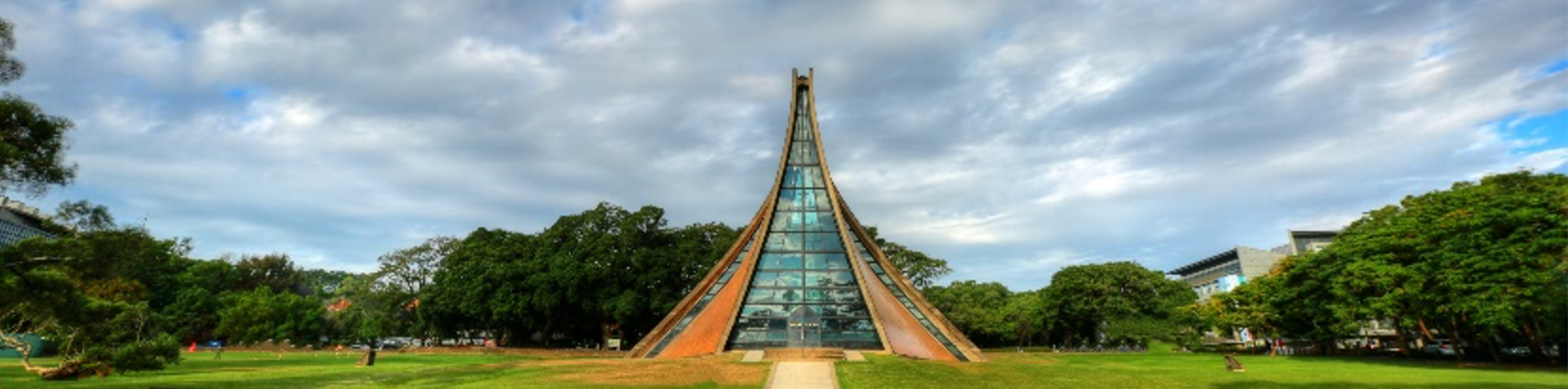
Tunghai University was established in 1955 and it is located on the level plateau of Taichung’s Tatu Mountain. Tunghai University, a liberal institution is full of scholarly elites and abundant resources and is well-known for its beautiful campus. Tunghai has 9 colleges, 34 departments and 35 Master’s programs (1 independent Master’s program and 13 In-Service Master’s programs) and 14 PhD programs.
Tunghai currently has 9 colleges: College of Arts, College of Science, College of Engineering, College of Management, College of Social Sciences, College of Agriculture, College of Fine Arts and Creative Design, College of Law, and International College. Tunghai has a student body of approximately 17,000 students and close to 500 teachers (88% of assistant professors and above). The total area of Tunghai’s campus reaches 1,333,096 square meter. With its spacious campus, Tunghai has the ideal teaching and learning environment for each and every Tunghai faculty and student.
Not only has Tunghai University received high rankings in reviews and topped recruiter rankings, but Tunghai also has received outstanding results from Ministry Of Education and has received 4.84 billion of subsidies from MOE’s Teaching Excellence Project for 6 consecutive years. With the above mentioned outstanding review results and MOE subsidies received, they have shown that Tunghai’s constant pursuit of excellence in both teaching and overall university development have been publicly recognized.
Tunghai University is the first and only educational institution in Taiwan that offers a complete education program from kindergarten to PhD program. Also, Tunghai University is the first to establish and introduce General Education and Student Labor Program system in Taiwan. The pioneering programs have served as role models for other universities in Taiwan. Besides its pioneering programs, Tunghai was also the first to offer open library stacks in Taiwan.
Tunghai University is renowned for its picturesque campus and landmarks, which provide an ideal environment to conduct teaching and research. Luce Chapel is one of Tunghai’s most famous and visited landmarks. The Luce Chapel, the world-known architectural masterpiece, was designed by architecture masters I. M. Pei and C. K. Chen. Besides the Luce Chapel, Tunghai is also well-known for its scenic spots such as the campus mall, Tunghai Lake, traditional Chinese style buildings and the spacious Tunghai farm.
With the ideals of the founding spirit of Christianity, the emphasis on holistic education and the development of students’ educational, academic and service development, it is hoped that ideal graduates of Tunghai University will not only possess the knowledge in their fields of expertise, critical thinking skills, problem solving skills, interpersonal communications skills, but also they are confident, responsible graduates with high moral and ethical standards and have appreciation in arts and humanity and are socially aware of the needs of the society. As a result, Tunghai university continues to top the rankings of corporate recruiters and has continued to receive outstanding reviews from the Ministry of Education.
Tunghai University values both teaching and service. Through the Student Labor Program, students develop their sense of responsibility and understand the importance of volunteerism and service. Tunghai University also values the quality of English learning. By providing small class sized English classes, the effectiveness of its English learning program have receive great reviews. Also, Tunghai University has the best Center of Continuing Education in Taiwan.
By establishing various key interdisciplinary research centers, such as the Center of Chinese Studies, the Life Science Research Center, Center Nanoscience and Technology, Center for Tropical Ecology and Biodiversity, Software Engineering & Technology Center, Tunghai has been proactively staying in sync with the latest global trends in research and development. Tunghai University will continue to follow its founding pioneering spirit and its school motto of Truth, Faith and Deed, Tunghai University will continue to innovate and make its unique contribution to higher education in Taiwan.
Project Overview:
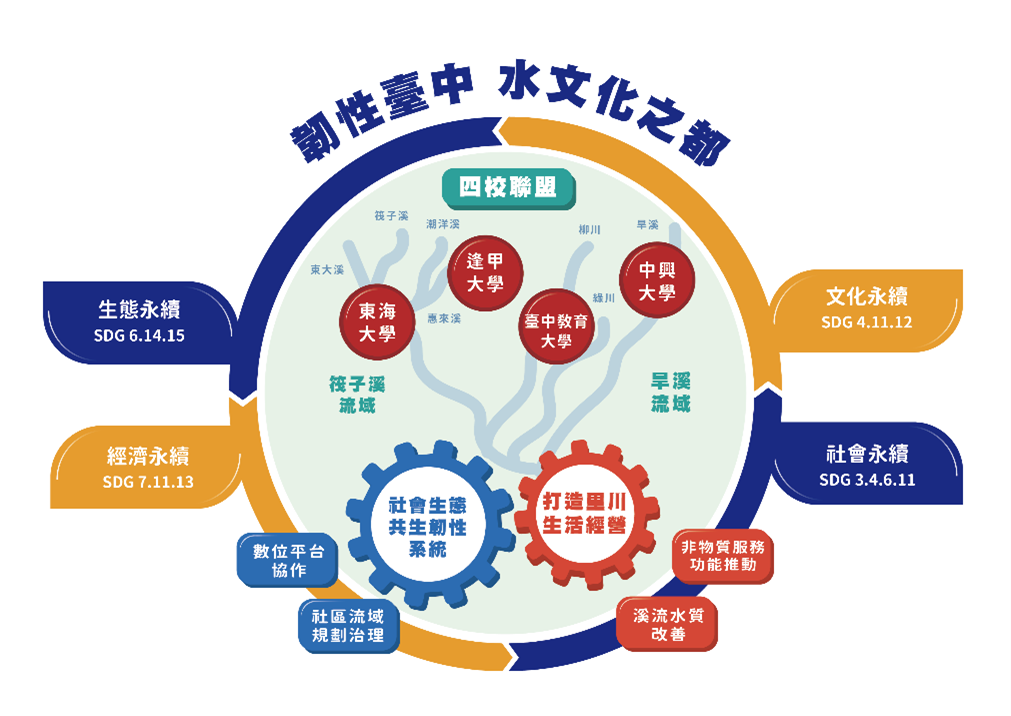
This project is led by Tunghai University, in collaboration with Feng Chia University, National Chung Hsing University, and National Taichung University of Education. Focusing on river basins in Taichung City, the project covers seven rivers and urban drainage systems. It addresses ecological, economic, social, and cultural dimensions, while leveraging university research capacity to empower local communities to protect water environments. The project aims to implement river restoration planning and cultivate local talent, putting the vision of river stewardship into practice.
Detailed Content:
1.Cross-university collaboration framework:Tunghai University focuses on ecological surveys and community advocacy for the Fazi River and Dongda River, promoting pollution prevention at source, volunteer training, and the restoration of blue-green ecological corridors in local communities. Feng Chia University applies hydraulic engineering technologies to develop micro-hydropower generation and stream water-level monitoring systems, while also promoting clean energy and watershed safety education. National Chung Hsing University conducts microbial pollution investigations in the Dahan River basin and manages invasive species control, building environmental datasets and advancing water environment education in rural and international contexts. National Taichung University of Education integrates fine arts and digital content design to develop local cultural digital teaching materials and 3D cultural products for the Liuchuan River, linking community memory with artistic creation through educational outreach.
2.Digital platform:Establish a “Four-University River Information Integration Platform,” evolving from a data display system into a decision-support system.
3.Curriculum integration:Offer 27 related courses and develop cross-university course enrollment and co-teaching arrangements, combining field techniques with design-thinking workshops.
4.Governance mechanism:Promote community-based watershed governance, stream water quality improvement, and ecological engineering solutions based on nature-based approaches.
Expected Outcomes:
1.Deepening watershed learning:Enhance understanding of river ecosystems among students, faculty, and local residents, and implement university social responsibility in practice.
2.Policy contribution:The four-university alliance holds regular quarterly consultation meetings with the Water Resources Bureau. Through long-term stream monitoring and research, it produces water environment reports, which are further used in the proposal mechanism of these meetings as policy recommendations for the city government’s watershed management plans.
3.Resource integration and sustainability:Establish MOUs with enterprises located near the watershed, and collaborate with media for advocacy to ensure continuous external resource investment.
4.International engagement:Promote overseas field study programs, international volunteer service, and cross-national collaboration with institutions such as the Ramsar Center Japan. Also support student participation in international conferences (e.g., JPGU) to share Taiwan’s experience in water environment conservation.
“City Glow” SDGs Sustainable Light Art Exhibition Series Documentary:https://www.youtube.com/watch?v=UXIm7DOUKWI&t=5s
Dongda River
For example, the Dongda River focuses on reducing oil and wastewater pollution from nearby commercial areas, while the Fazi River and the Hanxi Drainage System serve as important ecological blue-green corridors connecting the Dadu River and the Dajia River basins, forming key ecological linkages across the region.
Fazi River
For example, the Dongda River focuses on reducing oil and wastewater pollution from nearby commercial areas, while the Fazi River and the Hanxi Drainage System serve as important ecological blue-green corridors connecting the Dadu River and the Dajia River basins, forming key ecological linkages across the region.
Chaoyang River
For example, the Dongda River focuses on reducing oil and wastewater pollution from nearby commercial areas, while the Fazi River and the Hanxi Drainage System serve as important ecological blue-green corridors connecting the Dadu River and the Dajia River basins, forming key ecological linkages across the region.
Huilai River
For example, the Dongda River focuses on reducing oil and wastewater pollution from nearby commercial areas, while the Fazi River and the Hanxi Drainage System serve as important ecological blue-green corridors connecting the Dadu River and the Dajia River basins, forming key ecological linkages across the region.
Liuchuan Canal
For example, the Dongda River focuses on reducing oil and wastewater pollution from nearby commercial areas, while the Fazi River and the Hanxi Drainage System serve as important ecological blue-green corridors connecting the Dadu River and the Dajia River basins, forming key ecological linkages across the region.
Luchuan Canal
For example, the Dongda River focuses on reducing oil and wastewater pollution from nearby commercial areas, while the Fazi River and the Hanxi Drainage System serve as important ecological blue-green corridors connecting the Dadu River and the Dajia River basins, forming key ecological linkages across the region.
Hanxi Drainage
For example, the Dongda River focuses on reducing oil and wastewater pollution from nearby commercial areas, while the Fazi River and the Hanxi Drainage System serve as important ecological blue-green corridors connecting the Dadu River and the Dajia River basins, forming key ecological linkages across the region.
Liu, Jeng
Vice President, Tunghai University (Aug. 2022 – Present) Dean of Academic Affairs, Tunghai University (Feb. 2022 – Aug. 2022) Distinguished Professor, Tunghai University (2018 – Present) Visiting Professor, Rikkyo University, Tokyo, Japan (Apr. 2019 – Jun. 2019) Dean, College of Social Sciences, Tunghai University (Aug. 2015 – Jul. 2018) Visiting Scholar, Doshisha University, Kyoto, Japan (Jun. 2015 – Sep. 2015) Editor-in-Chief, Taiwanese Journal of Sociology (Aug. 2014 – Jul. 2016) Chair, Department of Sociology, Tunghai University (Aug. 2012 – Jul. 2015) Visiting Scholar, City University of New York, USA (Feb. 2012 – Jul. 2012) Associate Vice President for R&D, Tunghai University (Aug. 2009 – Jan. 2012) Professor, Department of Sociology, Tunghai University (Aug. 2008 – Present)
Tso, I-Min
Director, Office of Experiential Learning and Social Practice ,Tunghai University (August 2018 – Present) Director, Center for General and Core Curriculum, Tunghai University (August 2018 – July 2019) Dean, Poya school ,Tunghai University (September 2014 – January 2018) Distinguished Professor, Department of Life Science, Tunghai University (August 2015) Professor, Department of Life Science, Tunghai University (August 2006) Associate Professor, Department of Life Science, Tunghai University (February 2003) Assistant Professor, Department of Life Science, Tunghai University (August 1998)
Lee, Li-hui ( Newsletter Editorial Committee Member)
Associate Professor, Tunghai University (February 2017 - Present) Department Chair, Department of Industrial Design, Tunghai University (February 2018 - January 2021) Co-Principal Investigator, Ministry of Education University Social Responsibility (USR) Program Phase III (2023-2024): "Dadu Mountain Local Educational Innovation 2.0" Co-Principal Investigator, Ministry of Education University Social Responsibility (USR) Program Phase II (2020-2022): "Dadu Mountain Local Educational Innovation" Co-Principal Investigator, Ministry of Education University Social Responsibility (USR) Program Phase II (2018-2019): "Dadu Mountain Intergenerational Holistic Empowerment and Innovation Development Program for Children, Adolescents, and Youth"
張瑜珊 (Operations Committee Member)
2023.08~ Present Chair, Department of Japanese Language and Culture, Tunghai University 2021.08~Present Associate Professor, Department of Japanese Language and Culture, Tunghai University 2016.08~2021.07 Assistant Professor, Department of Japanese Language and Culture, Tunghai University 2015.08-2016.07 Project Assistant Professor, Department of Applied Japanese, DaYeh University. 2012.08-2015.07 Assistant Professor, Department of Applied Japanese, Hsin Sheng Junior College of Medical care and management